The short version
- If something seems urgent right now, like chest pain, trouble breathing or sudden confusion, call 911 or your local emergency number first.
- For the missed or doubled dose itself, call her pharmacist. What to do depends on the medication.
- Then fix the list: each bottle, what it’s for, and when she takes it. Ask the pharmacist to review it.
- Agree with her on what happens after the next missed dose, so nobody’s improvising.
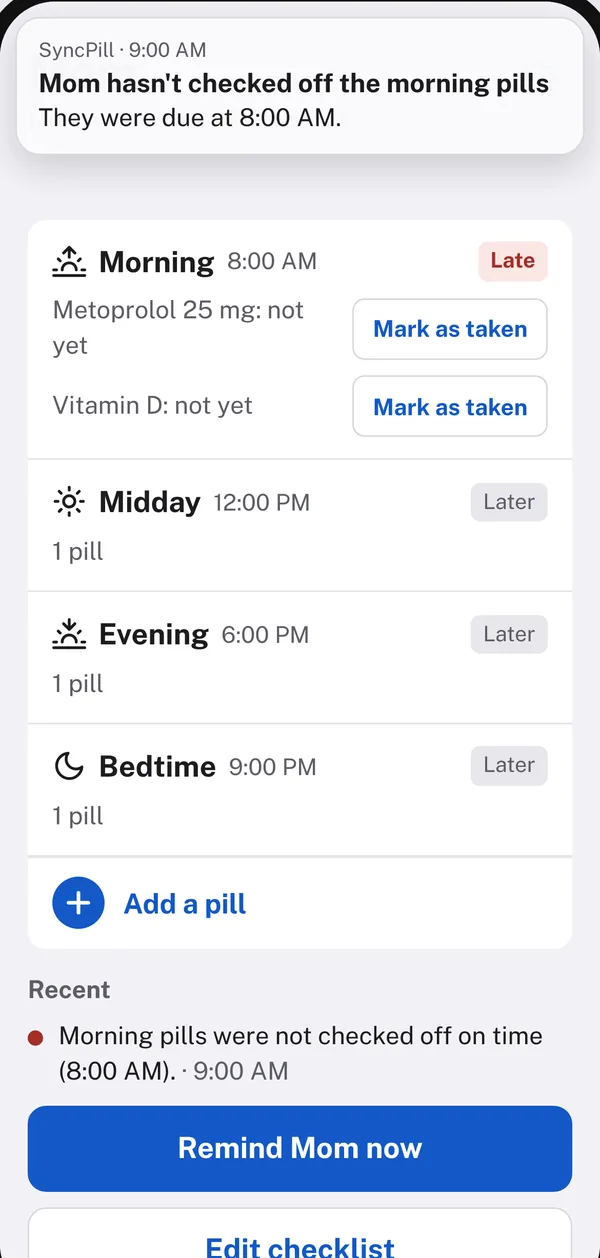
- A reminder app with family alerts can tell you the same day if a dose goes unchecked.
Why don’t parents mention missed doses?
Most people don’t announce a missed dose. Some honestly don’t remember. Others don’t want to worry their kids, or they worry that one slip means losing some independence. A pillbox with a full Tuesday slot tells you something, but only if you happen to be standing in the kitchen.
What should you do first?
- Call the pharmacist about that dose. Whether a missed pill can be taken late, or what to do after a double dose, depends on the medication. Have the bottle in hand so you can read them the label.
- Get the list right. Sit down with every bottle, including vitamins and anything she buys without a prescription. Write down what each one is for and when she takes it. The FDA suggests keeping that list current and sharing it with each of her providers (FDA). Our medication list template is a decent place to start.
- Ask for a full medication review. In the US, if she has a Medicare drug plan and takes medicines for more than one long-term condition, she may qualify for a free review with a pharmacist. It comes with a written summary and an updated list (Medicare). In Canada, ask her pharmacist whether your province offers something similar.
- Ask if the routine can be simpler. Fewer times of day, or pills sorted into dated blister packs by the pharmacy, are both worth asking about.
- Agree on what happens after a missed dose. A text? A call? Nothing unless it happens twice? Decide while things are calm, and let her have a say. Here’s a guide on that conversation.
- Tell her doctor about anything that seemed off, like confusion, dizziness or a fall. The National Council on Aging recommends reporting new symptoms like these promptly (National Council on Aging). A reminder can help with forgetting. It can’t explain why doses are being missed.
What should you ask the pharmacist?
Bring the list and these questions. Most pharmacists are glad to go through them, and it rarely takes long.
| Question | Why it helps |
|---|---|
| If she misses this one, what should she do? | The answer differs from one medication to the next. |
| What if she takes it twice? | Some are more forgiving than others. Write the answer down. |
| Can any of these be taken at the same time of day? | Fewer times of day, fewer chances to forget. |
| Could the pharmacy sort them into blister packs? | She can see at a glance whether today’s pocket is empty. |
| Is there anything here she no longer needs? | Lists grow over the years, and a stopped medicine can linger on someone’s list. |
Write the answers next to each medication on her list.
How do families keep track after a scare?
Some families use a pill organizer and a daily call. Others use a dispenser that locks between doses. A reminder app fits when your parent has a smartphone and you’d like to hear about a missed dose the same day, not the following week. SyncPill runs on two phones: your parent's shows what's due, with a big I took it button, and yours shows what's been checked off.
You hear about it the same day
If a dose isn’t checked off after 30 minutes, an hour or two hours (you pick), you get one alert on your phone.
Not much for her to learn
Her screen shows what’s due now and a big I took it button. No account or password on her side, and reminders ring without Wi-Fi.
A photo for each bottle
So at 8 a.m. she’s matching a picture instead of reading a label.
Changes from your phone
If the doctor changes something, edit it on your phone and it updates on hers.
“Simple and to the point. Effective and easy to use for personal use or to assist as a caregiver.”
What SyncPill won’t do
SyncPill records a tap on her phone. It can’t tell you a pill was actually swallowed, it doesn’t give medical advice, and it doesn’t check for interactions. If the scare involved confusion or a fall, her doctor needs to hear about it.
Questions families ask
Will she feel watched?
Some parents do at first. It tends to go better when she picks the reminder times herself and you agree ahead of time on what an alert means. It may also mean fewer “did you take your pills?” calls, which she might not miss.
Will SyncPill stop her from taking a dose twice?
No. It shows when each dose was checked off, which helps, but it can’t stop her from taking a pill twice. Dated blister packs are better at that, and the two work well together.
What if she doesn’t have a smartphone?
SyncPill needs an iPhone or Android phone on her end. If she uses a basic phone, a pharmacy blister pack and a regular check-in call might suit her better.
Can I try it before she installs it?
Yes. The live demo runs in your browser and shows both screens.
Sources
Official pages we used for this article, checked November 25, 2026:
Try it for a week
Free on your parent’s phone. You get 7 days free, then $1.99 a month or $14.99 a year (USD), for two helpers. Cancel in your App Store or Google Play settings anytime.
SyncPill is a reminder tool, not a medical device. It records taps; it can’t confirm a pill was swallowed. Follow the doctor’s or pharmacist’s instructions. Medical disclaimer.