The short version
- Pick one person to keep the medication list. The rest of you read it.
- Decide who hears about a missed dose first, and who backs them up.
- Ask the pharmacist which medications matter most if one is missed.
- Split the work by what each of you can do. It doesn’t need to be even.
- Include your parent in the plan while they can weigh in.
Why does shared care get tense?
It’s rarely about the pills themselves. It’s about who knows what, and when. The sibling who’s there sees most of it and gets tired of reporting it. The ones who aren’t there feel out of the loop and ask more questions, which makes the first one more tired. A shared view of the basics takes some of that pressure off.
What should siblings agree on?
- Who keeps the list. One person updates it, and the rest of you read it. That alone heads off a lot of confusion.
- Who hears about a missed dose first. Usually whoever lives closest, with a named backup for weekends and trips.
- What counts as a problem. A skipped vitamin and a skipped blood pressure pill aren’t the same. Ask the pharmacist which ones matter most, then agree on what’s worth a phone call.
- How news gets shared. A short weekly update in the group chat can replace a lot of scattered texts.
- Who covers which costs. Even small ones, like pharmacy delivery or an app subscription, so nobody keeps a quiet tally.
University of Illinois Extension suggests making the plan together, including your parent while they can still weigh in, and revisiting it as things change (University of Illinois Extension).
Who does what? A simple split
| Role | Often suits | What it involves |
|---|---|---|
| List keeper | The sibling who goes to appointments | Updates the list after each doctor or pharmacy change |
| First to check | Whoever lives closest | Gets the missed-dose alert and checks in |
| Backup | A sibling with a flexible schedule | Covers weekends, trips and sick days |
| Refills and paperwork | A sibling who lives far away | Insurance calls, refill reminders, pharmacy delivery |
| Support | Anyone | Regular calls to your parent, and breaks for the main helper |
The split doesn’t need to be equal. It needs to be clear.
How can two siblings see the same checklist?
SyncPill was made for families, so a subscription covers two helpers on one parent’s checklist. SyncPill runs on two phones: your parent's shows what's due, with a big I took it button, and yours shows what's been checked off.
Two helpers, one subscription
You and one sibling see the same checklist and the same check-offs. One of you pays, the other joins for free.
Both of you get the alert
If a dose isn’t checked off, each helper gets an alert after the wait they picked, so the one nearby isn’t the only one who knows.
Each check-off has a time
You can see when each dose was checked off, which cuts down on “did she take them?” texts.
One list, kept current
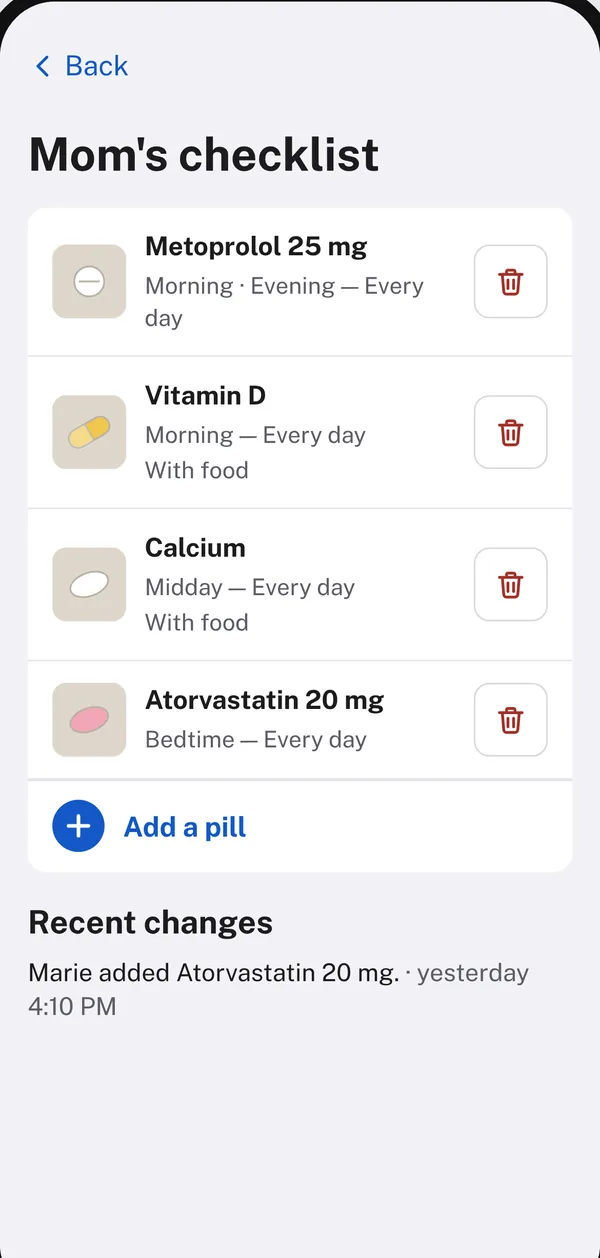
When one of you changes a medication, it updates on Mom’s phone and on the other helper’s.
“For my family, this app communicates between phones and is easy to use without unnecessary features”
What SyncPill won’t do
SyncPill covers two helpers per subscription. If there are three or more of you, two can use the app and pass news along to the rest. It also won’t settle who does more, though seeing the same information can make that conversation easier.
Questions families ask
Can three of us use it?
One subscription covers two helpers right now. If there are more of you, the two with the app can share updates with the others.
Do we both have to pay?
No. One helper subscribes and invites the second, at no extra cost.
My brother has Android and I have an iPhone. Is that okay?
Yes. SyncPill works across both, including Mom’s phone.
What if Mom doesn’t want all of us involved?
That’s her call. Some parents are comfortable with one helper and not two. Start with what she’s okay with.
Sources
Official pages we used for this article, checked November 25, 2026:
Try it for a week
Free on your parent’s phone. You get 7 days free, then $1.99 a month or $14.99 a year (USD), for two helpers. Cancel in your App Store or Google Play settings anytime.
SyncPill is a reminder tool, not a medical device. It records taps; it can’t confirm a pill was swallowed. Follow the doctor’s or pharmacist’s instructions. Medical disclaimer.